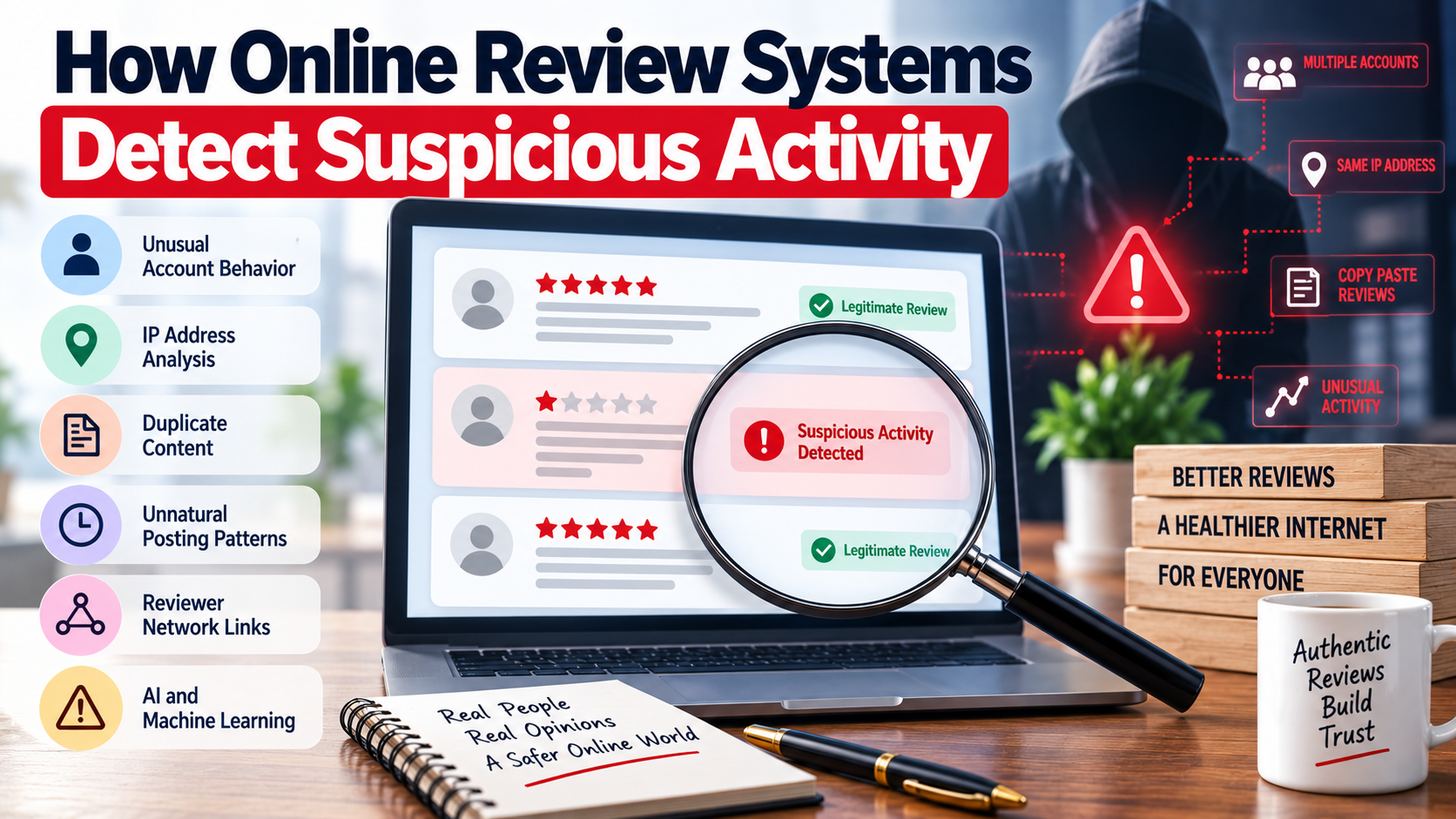
Online reviews have become one of the most influential factors in consumer decision-making. Whether customers are choosing a restaurant, hiring a contractor, booking a hotel, or purchasing software, they often rely on reviews to evaluate a business’s credibility. Because reviews carry so much influence, review platforms work continuously to detect suspicious activity that could reduce the reliability of their systems.
To protect users and maintain trust, many review platforms use a combination of automated technology, machine learning, and human moderation to identify reviews or account behavior that may violate their policies. While the exact methods differ by platform and are not fully disclosed, businesses can benefit from understanding the general principles behind review moderation.
This guide explains how online review systems detect suspicious activity, why reviews may be flagged, and how businesses can maintain ethical review practices.
Why Review Platforms Monitor Suspicious Activity
Review platforms aim to ensure that reviews reflect genuine customer experiences.
Monitoring suspicious activity helps:
- Protect consumers
- Reduce spam
- Detect fake reviews
- Improve review quality
- Maintain platform credibility
- Support fair competition
- Build public trust
- Prevent manipulation
Reliable reviews benefit both customers and legitimate businesses.
What Is Suspicious Review Activity?
Suspicious activity generally refers to behavior that appears inconsistent with normal customer review patterns or may violate a platform’s policies.
Examples may include:
- Large numbers of reviews posted in a short period
- Multiple reviews from newly created accounts
- Duplicate review content
- Reviews from accounts showing unusual activity
- Coordinated review campaigns
- Conflicts of interest
- Spam or promotional content
- Reviews unrelated to an actual customer experience
Whether content violates a platform’s rules depends on its specific policies and review process.
Automated Detection Systems
Most major review platforms use automated systems to analyze review activity.
These systems may evaluate:
- Posting patterns
- Account activity
- Review frequency
- Language similarities
- Behavioral signals
- Historical activity
- Technical indicators
- Content quality
Automation allows platforms to process large volumes of reviews efficiently.
Machine Learning
Many review platforms use machine learning models to identify unusual behavior.
These systems can learn from previous moderation decisions and may help detect patterns associated with:
- Spam
- Fake reviews
- Coordinated activity
- Policy violations
- Suspicious account behavior
Machine learning continuously improves as new data becomes available.
Pattern Analysis
Review systems often analyze patterns rather than evaluating individual reviews in isolation.
They may look for:
- Multiple reviews submitted within minutes
- Similar wording across different accounts
- Repeated posting behavior
- Sudden rating spikes
- Unusual geographic activity
- Abnormal account interactions
Pattern analysis helps identify activity that differs from normal user behavior.
Account Evaluation
Platforms may evaluate reviewer accounts based on factors such as:
- Account history
- Review consistency
- Activity over time
- Profile completeness
- Previous policy violations
Long-established accounts with consistent activity may appear more reliable than newly created accounts, although each platform uses its own evaluation methods.
Content Analysis
Review platforms may analyze review content for characteristics associated with policy violations.
Examples include:
- Duplicate text
- Promotional language
- Irrelevant content
- Offensive language
- Harassment
- Threats
- Spam
- Misleading information
Content analysis supports the overall moderation process.
User Reports
In addition to automated systems, review platforms often allow users and businesses to report reviews that they believe violate platform policies.
Reported reviews may be evaluated for:
- Policy compliance
- Authenticity
- Relevance
- Prohibited content
Reporting does not guarantee that a review will be removed.
Human Moderation
Although technology performs much of the initial screening, some situations may involve human review.
Human moderators may evaluate:
- Complex reports
- Appeals
- Context-specific situations
- Policy interpretation
- Evidence provided by users
The extent of manual review varies between platforms.
Why Genuine Reviews May Be Delayed or Hidden
Occasionally, authentic reviews may not appear immediately.
Possible reasons include:
- Automated quality checks
- Ongoing account verification
- System updates
- Temporary moderation processes
- Technical reviews
A delay does not necessarily mean the review violated platform policies.
Why Businesses Should Avoid Review Manipulation
Attempts to manipulate reviews can damage long-term credibility.
Businesses should avoid:
- Buying fake reviews
- Posting reviews about their own business
- Asking employees to submit misleading reviews
- Coordinating mass review campaigns
- Offering incentives solely for positive reviews
- Creating multiple reviewer accounts
Ethical review practices build stronger customer trust.
Encourage Authentic Customer Feedback
The best way to build a reliable review profile is through genuine customer experiences.
Businesses can:
- Deliver excellent service
- Ask satisfied customers for honest feedback
- Make reviewing simple
- Respond professionally to reviews
- Learn from customer suggestions
Authentic reviews provide long-term value.
Monitor Your Online Reputation
Regular monitoring helps businesses identify unusual activity and customer concerns.
Monitor:
- Review platforms
- Search engine results
- Social media mentions
- Business directories
- News articles
- Industry-specific websites
Consistent monitoring supports proactive reputation management.
Best Practices for Ethical Review Management
Businesses should:
- Encourage honest reviews
- Respond respectfully to customer feedback
- Follow each platform’s policies
- Maintain accurate business information
- Improve customer service
- Monitor review activity regularly
- Avoid deceptive practices
- Focus on long-term credibility
Ethical behavior strengthens brand reputation.
Common Misconceptions
Several myths exist about review moderation.
Common misunderstandings include:
- Every negative review is fake.
- Reporting a review guarantees removal.
- Platforms remove reviews based only on ratings.
- Buying reviews improves long-term reputation.
- Businesses can control which reviews appear.
Understanding platform policies helps businesses maintain realistic expectations.
Long-Term Benefits of Ethical Review Practices
Businesses that follow ethical review practices often experience:
- Greater customer trust
- Stronger brand credibility
- Better online reputation
- Higher-quality customer engagement
- Improved local search visibility
- Increased customer loyalty
- Sustainable business growth
- Long-term competitive advantages
Trust is built through authenticity and consistency.
Conclusion
Online review systems use a combination of automated technology, machine learning, pattern analysis, user reports, and, in some cases, human moderation to detect suspicious activity and maintain the integrity of their platforms. While the exact methods differ between review websites, the overall goal is to ensure that customers have access to authentic and trustworthy feedback.
Businesses should focus on earning genuine reviews through excellent customer service rather than attempting to manipulate review systems. By understanding how review moderation works, following platform policies, and maintaining ethical review practices, organizations can build stronger customer trust and a more resilient online reputation.
Frequently Asked Questions (FAQs)
How do online review platforms detect suspicious activity?
Many review platforms use automated systems, machine learning, pattern analysis, account evaluation, and user reports to identify activity that may violate their policies.
Can genuine reviews be flagged?
Yes. In some cases, authentic reviews may be temporarily delayed or reviewed as part of automated quality checks or moderation processes.
Does reporting a review guarantee its removal?
No. Reporting a review only requests that the platform evaluate it. Removal decisions are based on the platform’s policies and moderation process.
Why do review platforms monitor user activity?
Review platforms monitor activity to reduce spam, detect fake reviews, protect consumers, maintain trust, and ensure reviews reflect genuine customer experiences.
Should businesses buy positive reviews?
No. Purchasing fake reviews or attempting to manipulate review systems may violate platform policies and can damage a business’s credibility if detected.
What is the best way to build a strong review profile?
The most effective approach is to provide excellent customer service, encourage authentic customer feedback, respond professionally to reviews, and follow each platform’s guidelines.
Can businesses control which reviews appear online?
Generally, no. Businesses cannot choose which genuine customer reviews remain visible. Review platforms determine moderation decisions based on their published policies and internal review processes.
Leave a Reply