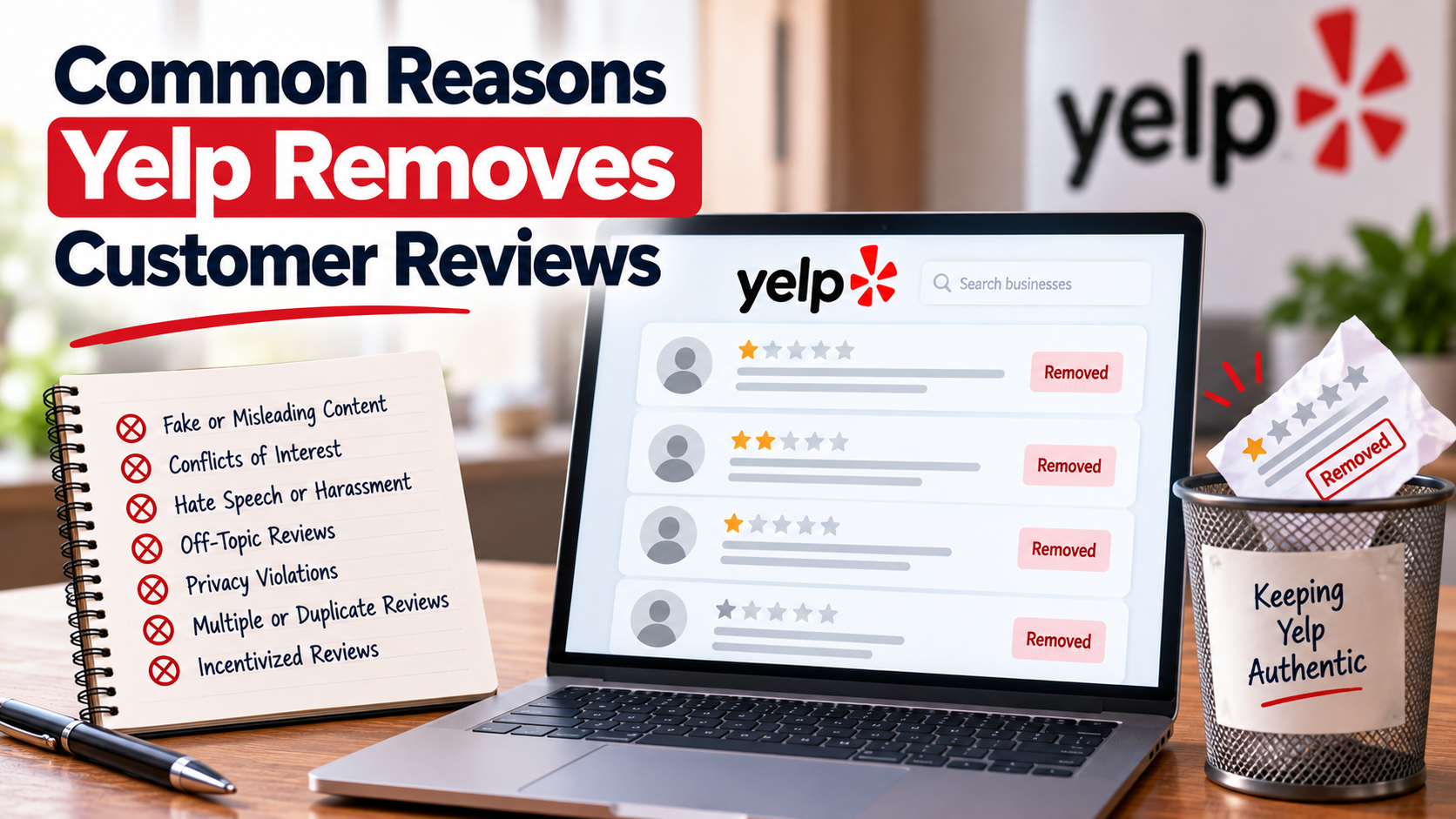
Online reviews are one of the most influential factors in a customer’s decision-making process, and Yelp is among the most recognized review platforms for local businesses. Restaurants, healthcare providers, home service companies, retailers, and many other businesses rely on Yelp reviews to build trust and attract new customers.
To maintain the quality and reliability of its platform, Yelp has policies that govern what types of reviews are allowed. While Yelp generally supports genuine customer feedback, it may remove or limit the visibility of reviews that violate its Content Guidelines or appear to compromise the integrity of the review system.
Understanding why Yelp removes certain reviews can help businesses manage their online reputation responsibly and set realistic expectations about the moderation process.
Why Yelp Moderates Reviews
Yelp’s moderation system is designed to ensure that reviews provide useful, authentic, and trustworthy information for consumers.
Review moderation helps:
- Improve review quality
- Reduce spam
- Protect consumers
- Encourage authentic customer experiences
- Maintain platform credibility
- Prevent review manipulation
- Support fair competition
- Build public trust
Not every reported review is removed, and not every negative review violates Yelp’s policies.
Fake Reviews
One of the most common reasons a review may be removed is because it appears to be fake.
Examples include:
- Reviews from people who were not genuine customers
- Fabricated customer experiences
- Reviews created to artificially improve or damage a business’s reputation
- Coordinated review campaigns
Yelp works to identify activity that may undermine the authenticity of its review system.
Spam Content
Reviews that primarily serve as spam may be removed.
Examples include:
- Repetitive content
- Promotional messages
- Unrelated advertising
- Links intended for marketing purposes
- Automated or mass-posted reviews
Spam reduces the usefulness of review platforms for consumers.
Conflicts of Interest
Yelp generally discourages reviews written by individuals with a conflict of interest.
Examples may include:
- Business owners reviewing their own company
- Employees reviewing their employer
- Competitors posting reviews about rival businesses
- Friends or family members posting biased reviews
Reviews should reflect independent customer experiences.
Reviews Unrelated to Customer Experiences
Reviews are intended to describe actual experiences with a business.
Content may be inappropriate if it focuses on topics unrelated to customer interactions, such as:
- Political opinions
- Personal disputes unrelated to the business
- Public controversies that do not involve customer experiences
- General commentary without firsthand experience
Keeping reviews relevant helps other consumers make informed decisions.
Harassment and Abusive Language
Yelp may take action against reviews containing:
- Harassment
- Personal attacks
- Threats
- Hate speech
- Discriminatory language
- Abusive behavior
Respectful communication contributes to a healthier review environment.
Impersonation
Reviews may violate Yelp’s policies if someone falsely claims to be another individual or misrepresents their identity.
Authentic reviewer identities help maintain trust in the platform.
Confidential or Personal Information
Reviews that disclose sensitive personal information may be removed.
Examples include:
- Phone numbers
- Home addresses
- Financial information
- Personal identification details
- Private communications without consent
Protecting privacy is an important part of Yelp’s moderation policies.
Illegal or Prohibited Content
Yelp may remove reviews that contain:
- Illegal content
- Fraudulent activity
- Encouragement of unlawful behavior
- Explicit threats
- Other material prohibited by its guidelines
Such content may violate both platform policies and applicable laws.
Suspicious Review Patterns
Yelp may analyze review activity for unusual behavior.
Examples include:
- Multiple reviews posted in a very short period
- Large numbers of reviews from newly created accounts
- Similar wording across multiple reviews
- Unusual account activity
- Coordinated review behavior
Review platforms often evaluate patterns rather than individual reviews alone.
Automated Moderation
Yelp uses automated systems to help evaluate reviews.
These systems may consider:
- Review content
- Posting patterns
- Account activity
- Language similarities
- Technical signals
- Historical behavior
Automation helps process large volumes of reviews efficiently.
User Reports
Businesses and users can report reviews they believe violate Yelp’s Content Guidelines.
After a report is submitted, Yelp may review the content to determine whether it complies with its policies.
Reporting a review does not guarantee its removal.
Negative Reviews Are Not Automatically Removed
Many businesses believe Yelp removes reviews simply because they are negative.
In reality, genuine negative reviews that comply with Yelp’s guidelines generally remain visible.
A review usually needs to violate a policy before moderation action is taken.
How Businesses Should Respond
Instead of focusing only on removal, businesses should:
- Respond professionally
- Address legitimate concerns
- Learn from customer feedback
- Improve customer service
- Monitor reviews regularly
Professional responses often demonstrate accountability and build customer trust.
Encourage Authentic Customer Reviews
The best way to build a strong Yelp profile is through genuine customer experiences.
Businesses should:
- Deliver excellent service
- Invite satisfied customers to share honest feedback
- Make it easy for customers to find their Yelp profile
- Avoid manipulating the review process
Authenticity supports long-term credibility.
Common Misunderstandings
Several myths surround Yelp’s moderation process.
Common misconceptions include:
- Every negative review can be removed.
- Reporting guarantees removal.
- Businesses can delete reviews themselves.
- More reports always lead to faster action.
- Buying reviews improves long-term reputation.
Understanding Yelp’s policies helps businesses manage expectations.
Long-Term Benefits of Ethical Review Management
Businesses that follow ethical review practices often experience:
- Greater customer trust
- Better online reputation
- Higher customer engagement
- Improved local visibility
- Increased customer loyalty
- Stronger brand credibility
- Sustainable business growth
- Long-term competitive advantages
Authentic customer relationships create lasting value.
Conclusion
Yelp removes customer reviews when they violate its Content Guidelines, such as through fake experiences, spam, harassment, conflicts of interest, impersonation, or other prohibited content. However, genuine negative reviews that reflect authentic customer experiences generally remain on the platform, even if they are critical.
Businesses should focus on delivering excellent customer service, encouraging honest feedback, responding professionally to reviews, and understanding Yelp’s moderation process. By following ethical review management practices and maintaining a customer-first approach, organizations can build stronger trust and protect their online reputation over the long term.
Frequently Asked Questions (FAQs)
Why does Yelp remove some customer reviews?
Yelp may remove reviews that violate its Content Guidelines, including fake reviews, spam, harassment, conflicts of interest, impersonation, or other prohibited content.
Does Yelp remove negative reviews automatically?
No. Genuine negative reviews that comply with Yelp’s policies generally remain visible. A review is not removed simply because it is critical.
Can businesses delete Yelp reviews?
No. Businesses cannot directly remove customer reviews. They can report reviews they believe violate Yelp’s policies, but Yelp decides whether any action is appropriate.
What is considered a fake Yelp review?
A fake review may include fabricated customer experiences, reviews from individuals who were not genuine customers, or coordinated efforts to manipulate a business’s rating.
Why are reviews from employees or competitors discouraged?
Reviews from people with conflicts of interest may not reflect independent customer experiences and can reduce trust in the review system.
What should businesses do if they believe a review violates Yelp’s policies?
Businesses should review Yelp’s Content Guidelines, gather any relevant information, and use Yelp’s official reporting process if they believe the review violates platform policies.
What is the best long-term strategy for managing Yelp reviews?
The most effective approach is to provide excellent customer service, encourage authentic customer feedback, respond professionally to reviews, monitor your Yelp profile regularly, and follow the platform’s review guidelines.
Leave a Reply