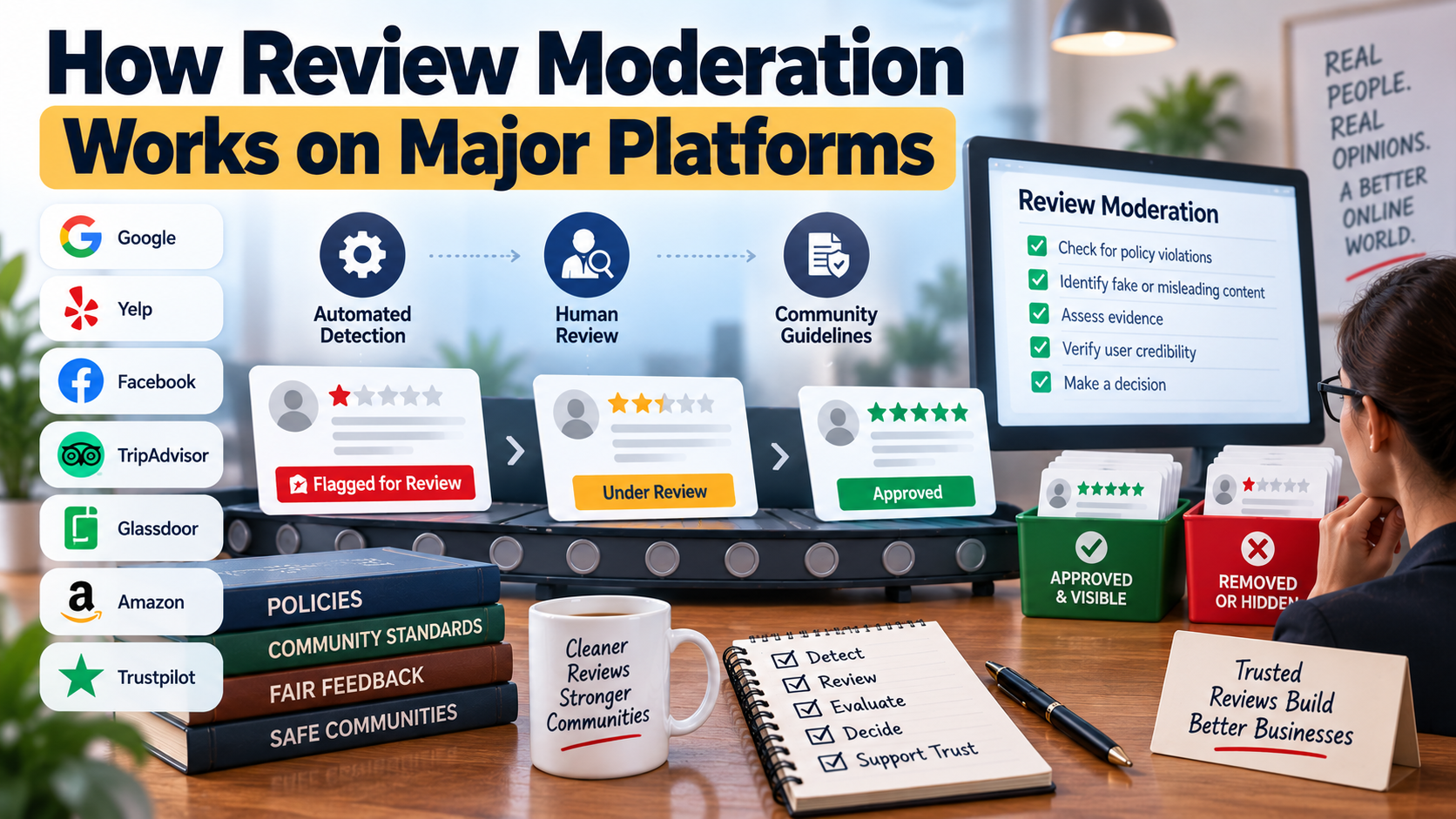
Online reviews have become an essential part of the customer decision-making process. Whether someone is choosing a restaurant, hiring a contractor, booking a hotel, or applying for a job, reviews often influence their final choice. To maintain trust and ensure that reviews remain useful, major review platforms use moderation systems to identify and address content that violates their policies.
Review moderation helps platforms balance two important goals: allowing genuine customer feedback while reducing spam, fake reviews, abusive content, and other policy violations. Although every platform has its own moderation process, most use a combination of automated technology, human review, and user reports.
This guide explains how review moderation generally works on major platforms and what businesses should know about the process.
Why Review Moderation Is Important
Review moderation helps create a trustworthy environment for both consumers and businesses.
Its primary objectives include:
- Promoting authentic customer feedback
- Reducing spam
- Preventing fake reviews
- Protecting users from abusive content
- Supporting fair competition
- Improving review quality
- Maintaining platform credibility
- Encouraging informed purchasing decisions
Without moderation, review platforms would be more vulnerable to manipulation and misleading information.
Common Review Platforms
Many businesses receive reviews across multiple platforms, including:
- Google Reviews
- Yelp
- Glassdoor
- Trustpilot
- Facebook Reviews
- TripAdvisor
- Better Business Bureau (BBB)
- Industry-specific review websites
Each platform has its own community guidelines and moderation policies.
Automated Moderation Systems
Most major platforms use automated systems to review large volumes of user-generated content.
These systems may analyze:
- Review content
- Posting frequency
- Duplicate submissions
- Account activity
- Technical signals
- Language patterns
- Unusual behavior
- Historical account information
Automation allows platforms to identify potentially problematic content quickly.
Artificial Intelligence and Machine Learning
Many review platforms use artificial intelligence (AI) and machine learning to improve moderation accuracy.
AI systems may help identify:
- Spam
- Fake review patterns
- Coordinated review campaigns
- Duplicate content
- Suspicious account behavior
- Unusual posting activity
AI assists moderation but does not always make final decisions independently.
Pattern Analysis
Platforms often examine behavioral patterns rather than evaluating reviews individually.
Examples include:
- Multiple reviews posted within a short period
- Similar wording across different reviews
- Large numbers of reviews from newly created accounts
- Repeated activity from related accounts
- Sudden changes in review patterns
Pattern analysis helps identify potential manipulation.
Content Evaluation
Platforms review content to determine whether it complies with their published guidelines.
Common policy violations may include:
- Spam
- Fake reviews
- Harassment
- Hate speech
- Threats
- Impersonation
- Promotional content
- Reviews unrelated to genuine customer experiences
Each platform defines prohibited content according to its own policies.
User Reports
Businesses and users can report reviews they believe violate platform guidelines.
When a report is submitted, the platform may evaluate:
- The reported content
- Supporting information
- Policy compliance
- Reviewer activity
- Context surrounding the review
Submitting a report starts a review process but does not guarantee that content will be removed.
Human Moderation
Although automation plays an important role, human moderators may review certain cases.
Manual review may be used when:
- Context is difficult to evaluate
- Appeals are submitted
- Serious allegations are involved
- Automated systems cannot make a clear decision
- Complex policy questions arise
Human reviewers apply the platform’s published guidelines during their evaluation.
Review Decisions
After moderation, platforms may decide to:
- Leave the review visible
- Remove the review if it violates policies
- Reduce the visibility of certain reviews
- Restrict accounts that repeatedly violate platform rules
- Request additional information in some situations
The specific outcome depends on the platform’s moderation policies.
Why Negative Reviews Often Remain Visible
One common misconception is that review platforms remove negative reviews simply because businesses disagree with them.
In reality, genuine customer opinions that comply with community guidelines generally remain visible.
Negative feedback alone is usually not considered a policy violation.
Why Some Reviews Are Removed
Reviews may be removed when they include prohibited content such as:
- Fake customer experiences
- Spam
- Harassment
- Hate speech
- Threats
- Impersonation
- Explicit content
- Reviews unrelated to the business
Each case is evaluated individually according to platform rules.
What Businesses Should Do
Businesses should approach review moderation responsibly.
Recommended practices include:
- Monitor reviews regularly
- Report reviews that may violate policies
- Respond professionally to customer feedback
- Encourage authentic customer reviews
- Follow each platform’s guidelines
Professional engagement helps strengthen customer trust.
Avoid Review Manipulation
Businesses should never attempt to manipulate review systems.
Avoid:
- Buying fake reviews
- Posting reviews about your own business
- Asking employees to submit misleading reviews
- Creating fake reviewer accounts
- Coordinating review campaigns
- Offering incentives solely for positive reviews
These practices may violate platform policies and damage credibility.
Build a Strong Review Profile
The best defense against occasional negative reviews is a strong collection of authentic customer feedback.
Focus on:
- Excellent customer service
- Honest customer communication
- Consistent service quality
- Ethical review requests
- Ongoing customer engagement
Authenticity builds long-term trust.
Monitor Your Online Reputation
Review moderation is only one part of reputation management.
Businesses should also monitor:
- Search engine results
- Social media mentions
- Business directories
- News articles
- Industry forums
A complete view of your online presence helps identify potential issues early.
Benefits of Ethical Reputation Management
Businesses that follow ethical review practices often experience:
- Greater customer trust
- Better online credibility
- Improved customer relationships
- Higher customer loyalty
- Stronger search visibility
- More balanced review profiles
- Better brand perception
- Sustainable business growth
Trust develops through consistent and transparent business practices.
Conclusion
Major review platforms use a combination of automated moderation, artificial intelligence, machine learning, user reports, pattern analysis, and human review to maintain the quality and integrity of their review systems. While each platform has its own policies and moderation procedures, the overall goal is to promote authentic customer experiences while reducing spam, fake reviews, and other forms of policy-violating content.
Businesses should understand that not every negative review qualifies for removal. Instead, long-term success comes from providing excellent customer service, encouraging genuine customer feedback, responding professionally to reviews, and monitoring online reputation consistently. Ethical reputation management builds stronger customer trust and creates a more resilient online presence.
Frequently Asked Questions (FAQs)
What is review moderation?
Review moderation is the process review platforms use to evaluate user-generated reviews and determine whether they comply with the platform’s community guidelines and content policies.
How do major review platforms detect suspicious reviews?
Many platforms use automated systems, artificial intelligence, machine learning, pattern analysis, user reports, and human moderators to identify reviews that may violate their policies.
Are negative reviews automatically removed?
No. Genuine negative reviews that comply with a platform’s guidelines generally remain visible. Negative feedback alone is not usually grounds for removal.
Can businesses report reviews they believe violate platform policies?
Yes. Most review platforms allow businesses to report reviews that may violate their guidelines. The platform then evaluates the report before making a decision.
Why do some reported reviews remain online?
A review may remain visible if the platform determines that it reflects a genuine customer experience and does not violate its published policies.
Can businesses remove reviews themselves?
No. Businesses generally cannot directly remove reviews. Only the review platform can decide whether a review should be removed based on its moderation policies.
What is the best long-term strategy for managing online reviews?
The most effective approach is to deliver excellent customer service, encourage authentic customer feedback, respond professionally to reviews, monitor your online reputation regularly, and follow each platform’s review guidelines.
Leave a Reply