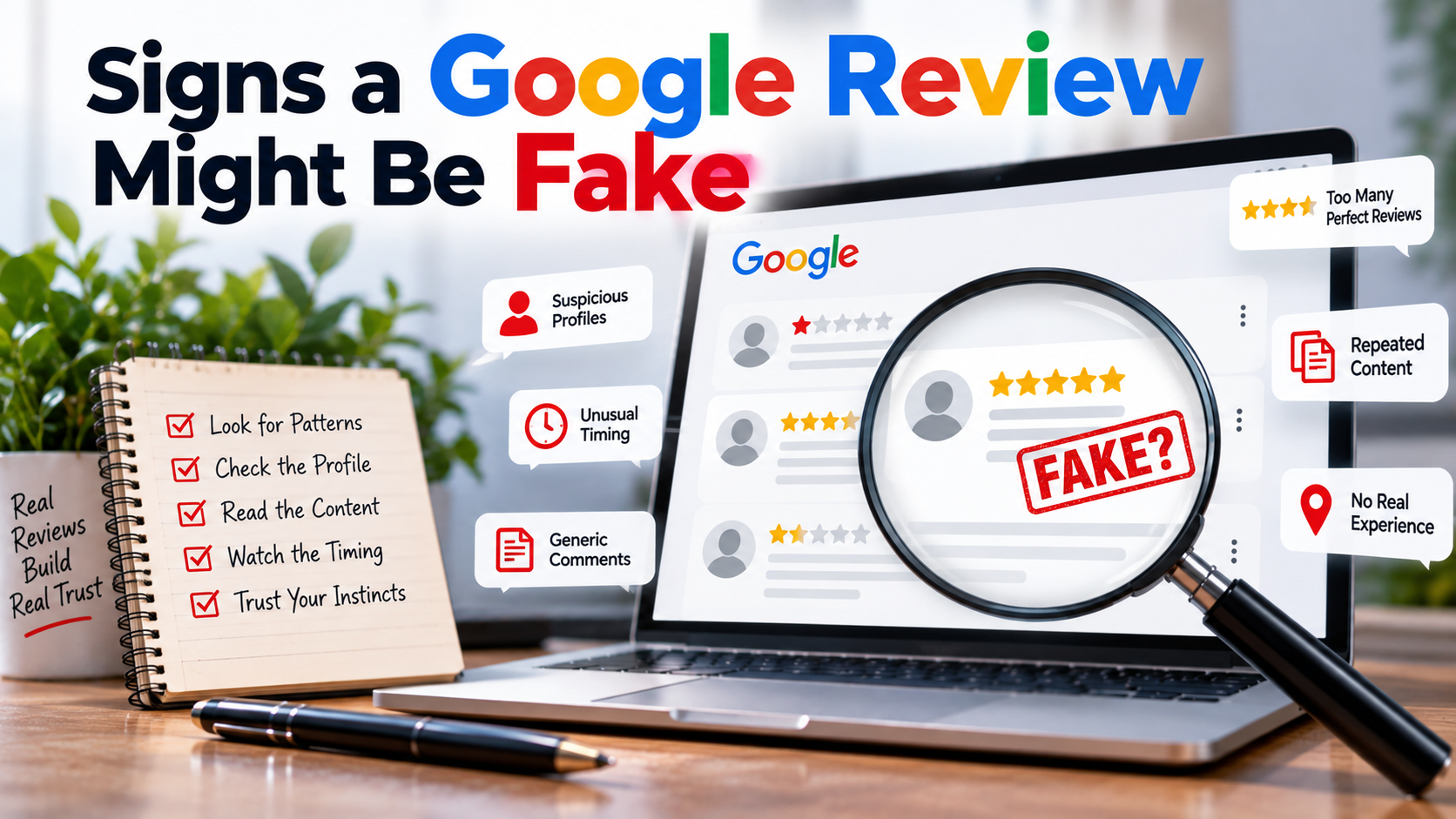
Google Reviews are one of the most trusted sources of customer feedback for businesses around the world. Potential customers often read reviews before choosing a restaurant, hiring a contractor, booking a service, or making a purchase. Because reviews influence business reputation and customer decisions, most reviews represent genuine experiences. However, businesses and consumers may occasionally encounter reviews that appear suspicious or inconsistent with authentic customer feedback.
A review that seems unusual is not automatically fake. Genuine customers can have very different opinions about the same business. Before assuming a review is false, it is important to evaluate it carefully and understand the difference between suspicious activity and legitimate customer criticism.
This guide explains common signs that a Google review might be fake, how businesses should respond, and why ethical reputation management is essential.
What Is a Fake Google Review?
A fake Google review is generally a review that intentionally misrepresents a customer experience or is created to manipulate a business’s reputation.
Examples may include:
- Reviews from people who never interacted with the business
- Fake positive reviews created to boost ratings
- Fake negative reviews intended to damage a competitor
- Reviews posted using multiple fake accounts
- Coordinated review campaigns
- Reviews generated through deceptive practices
Whether a review violates Google’s policies depends on the specific facts and Google’s review guidelines.
Sign 1: The Reviewer Was Never a Customer
One common warning sign is when a business cannot identify any record of the reviewer.
For example:
- No purchase history
- No appointment record
- No customer inquiry
- No communication history
- No identifiable interaction
However, businesses should remember that not every customer interaction creates an easily traceable record.
Sign 2: Extremely Vague Reviews
Some suspicious reviews provide almost no meaningful details.
Examples include:
- “Terrible business.”
- “Worst ever.”
- “Amazing service.”
Without additional context, it may be difficult to determine whether the review reflects a genuine experience.
That said, brief reviews are not automatically fake.
Sign 3: Identical or Repeated Wording
If multiple reviews contain nearly identical language, it may indicate unusual review activity.
Possible examples include:
- Duplicate sentences
- Repeated phrases
- Similar formatting
- Identical descriptions across different accounts
Patterns are often more meaningful than individual reviews.
Sign 4: Sudden Increase in Reviews
An unusually large number of reviews appearing within a short period may attract attention.
Examples include:
- Many reviews posted on the same day
- Rapid changes in ratings
- Multiple reviews with similar wording
- Several new reviewer accounts posting simultaneously
Rapid activity does not necessarily indicate policy violations but may warrant closer examination.
Sign 5: Reviewer Has No Profile History
Some reviewer profiles contain little or no visible activity.
Possible characteristics include:
- Newly created account
- Very few reviews
- Limited profile information
- Minimal account history
A new account alone does not prove a review is fake.
Sign 6: Reviews Across Unrelated Locations
Some suspicious accounts post reviews for businesses located in very different regions within a short timeframe.
For example:
- Restaurants in different countries
- Businesses across multiple cities
- Unrelated industries reviewed on the same day
Unusual reviewing patterns may indicate further review is appropriate.
Sign 7: Promotional or Commercial Language
Authentic customer reviews usually describe personal experiences.
Suspicious reviews may instead focus on:
- Marketing slogans
- Promotional messages
- Advertising language
- Sales-oriented content
- Repeated brand messaging
Google’s review policies generally discourage promotional content.
Sign 8: Personal Attacks Instead of Customer Feedback
Reviews intended to harm rather than inform customers may contain:
- Insults
- Harassment
- Offensive language
- Personal attacks
- Threats
Such content may violate platform policies depending on the circumstances.
Sign 9: Conflicts of Interest
Reviews may raise concerns if they appear to come from:
- Competitors
- Employees reviewing their own company
- Individuals with undisclosed personal interests
- People connected to the business inappropriately
Many review platforms have policies addressing conflicts of interest.
Sign 10: False Factual Claims
Some reviews may contain factual allegations that the business believes are incorrect.
Examples include:
- Claiming services that were never offered
- Describing incidents that never occurred
- Incorrect business information
- Misrepresentation of transactions
Businesses should carefully verify the facts before assuming a review is intentionally false.
What Businesses Should Do
If a review appears suspicious:
- Review the content carefully.
- Compare it with business records.
- Determine whether it may violate Google’s review policies.
- Report the review if appropriate.
- Respond professionally when suitable.
Avoid making assumptions without supporting evidence.
Continue Encouraging Authentic Reviews
A strong collection of genuine customer feedback reduces the impact of occasional suspicious reviews.
Businesses should:
- Deliver excellent customer service
- Invite honest customer reviews
- Make the review process convenient
- Thank customers for their feedback
- Follow Google’s review guidelines
Authenticity builds credibility.
Avoid Review Manipulation
Businesses should never:
- Buy fake reviews
- Create fake customer accounts
- Ask employees to submit misleading reviews
- Review their own business
- Organize deceptive review campaigns
Ethical practices support long-term trust.
Monitor Your Google Business Profile
Regular monitoring helps businesses identify unusual activity early.
Monitor:
- New reviews
- Rating changes
- Customer questions
- Business information
- Review trends
Early detection allows businesses to respond more effectively.
Build a Strong Reputation
The best protection against occasional suspicious reviews is an outstanding overall reputation.
Focus on:
- Customer satisfaction
- Transparent communication
- Consistent service
- Professional responses
- Helpful content
- Continuous improvement
Trust develops through consistent positive experiences.
Common Misconceptions
Several myths surround fake Google reviews.
Common misunderstandings include:
- Every negative review is fake.
- New reviewer accounts always post fake reviews.
- Reporting guarantees removal.
- Businesses can delete reviews themselves.
- Short reviews automatically violate Google’s policies.
Each review is evaluated individually according to Google’s published guidelines.
Benefits of Ethical Reputation Management
Businesses that manage reviews responsibly often experience:
- Greater customer trust
- Better online credibility
- Improved local visibility
- Stronger customer relationships
- Higher customer loyalty
- Balanced review profiles
- Increased referrals
- Sustainable business growth
Long-term success depends on authenticity rather than manipulation.
Conclusion
Fake Google reviews can affect customer trust and business reputation, but businesses should avoid assuming that every unusual or negative review is fraudulent. Signs such as identical wording, unusual posting patterns, promotional language, conflicts of interest, or false factual claims may justify closer review, but each situation should be evaluated carefully and objectively.
The most effective approach is to monitor your Google Business Profile regularly, encourage authentic customer feedback, respond professionally to reviews, and report content that may violate Google’s policies. By focusing on excellent customer service and ethical reputation management, businesses can build a trusted online presence that is resilient to occasional suspicious reviews.
Frequently Asked Questions (FAQs)
What is a fake Google review?
A fake Google review is generally a review that intentionally misrepresents a customer experience or is posted to manipulate a business’s reputation through deceptive practices.
How can businesses identify suspicious Google reviews?
Possible warning signs include no record of a customer interaction, identical wording across reviews, unusual posting patterns, promotional language, conflicts of interest, or false factual claims. These signs do not automatically prove a review is fake.
Can businesses remove fake Google reviews?
Businesses cannot directly remove reviews. They can report reviews they believe violate Google’s review policies, and Google determines whether any action is appropriate.
Are all negative Google reviews fake?
No. Many negative reviews reflect genuine customer experiences. Businesses should distinguish between legitimate criticism and reviews that may violate Google’s policies.
Should businesses respond to suspicious reviews?
If appropriate, a professional response can demonstrate transparency, clarify misunderstandings, and reassure potential customers while the review is being evaluated.
Does reporting a suspicious review guarantee removal?
No. Reporting a review requests that Google evaluate it, but removal depends on whether the review is found to violate Google’s published policies.
What is the best long-term strategy for protecting a Google review profile?
The most effective strategy is to provide excellent customer service, encourage honest customer reviews, monitor your Google Business Profile regularly, respond professionally to feedback, and follow Google’s review guidelines.
Leave a Reply