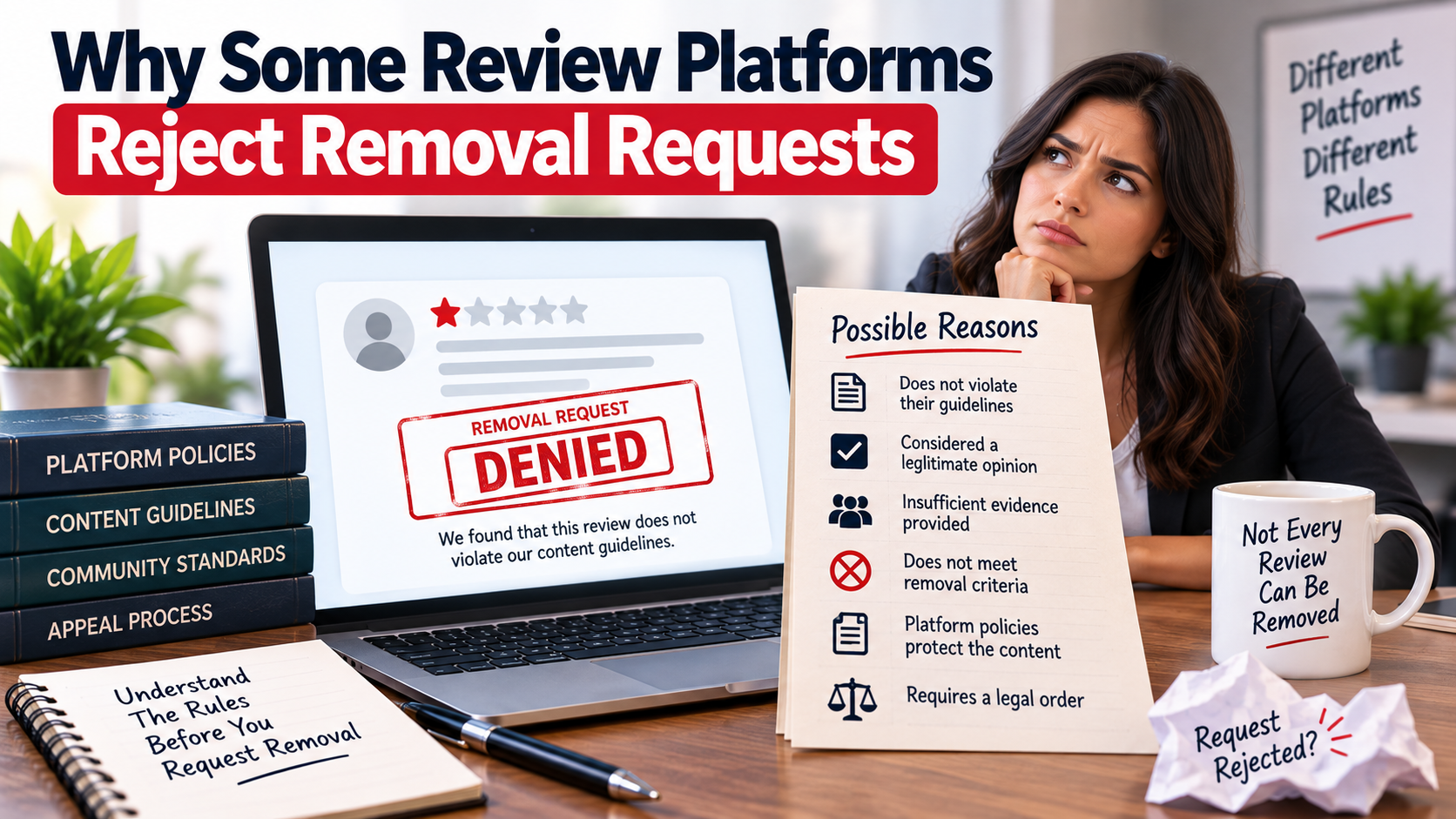
Online reviews have become one of the most influential factors in shaping a business’s reputation. Before choosing a product, booking a service, or contacting a company, many customers read reviews on platforms such as Google, Yelp, Glassdoor, Trustpilot, and industry-specific review websites. Because these platforms aim to provide reliable and balanced information, they generally do not remove reviews simply because they are negative.
Businesses sometimes submit removal requests after receiving unfavorable reviews, only to find that the platform rejects the request. Understanding why removal requests are declined helps businesses set realistic expectations and focus on effective long-term reputation management rather than relying solely on review removal.
This guide explains why review platforms reject certain removal requests, how moderation decisions are made, and what businesses can do instead.
Why Review Platforms Have Removal Policies
Most review platforms are designed to encourage authentic customer feedback while protecting the integrity of their review systems.
Their moderation policies help:
- Maintain transparency
- Protect consumers
- Encourage honest feedback
- Reduce spam
- Prevent review manipulation
- Build platform credibility
- Support fair competition
- Promote informed decision-making
As a result, platforms generally remove reviews only when they violate their published guidelines.
Negative Reviews Are Not Policy Violations
One of the most common reasons a removal request is rejected is because the review is simply negative.
For example, comments such as:
- “The service was slow.”
- “The product didn’t meet my expectations.”
- “I wouldn’t choose this company again.”
may express genuine customer opinions.
Although these reviews may affect a business’s reputation, they typically do not violate platform policies.
The Review Reflects a Genuine Experience
Many platforms allow reviews that describe real customer or employee experiences, even if they include criticism.
A review may remain visible if it:
- Describes an actual interaction
- Reflects personal opinions
- Complies with community guidelines
- Does not contain prohibited content
Disagreement with a review does not automatically justify its removal.
No Evidence of a Policy Violation
Review platforms generally evaluate whether reported content violates their published rules.
If there is insufficient evidence that a review includes prohibited content, the removal request may be rejected.
Examples of prohibited content often include:
- Spam
- Fake reviews
- Harassment
- Hate speech
- Threats
- Impersonation
- Explicit content
- Reviews unrelated to a genuine experience
Policies vary by platform.
Freedom of Opinion
Many review platforms recognize the importance of allowing users to express their opinions.
Personal opinions, even when critical, are generally treated differently from false factual statements.
For example:
Opinion:
“I wasn’t satisfied with the service.”
Potential factual claim:
“This company committed fraud.”
The distinction between opinion and factual assertions is an important factor in moderation decisions.
Insufficient Supporting Information
When businesses report reviews, platforms may not receive enough information to determine that a policy violation has occurred.
Providing accurate and relevant details during the reporting process may assist the platform’s review, although it does not guarantee removal.
Automated and Manual Moderation
Many review platforms use a combination of:
- Automated moderation systems
- Machine learning
- Pattern analysis
- User reports
- Human review in certain situations
The exact moderation process differs between platforms and is generally not fully disclosed.
The Review Complies With Platform Guidelines
A review may remain visible simply because it follows the platform’s rules.
For example, it may:
- Be respectful
- Describe a genuine experience
- Avoid prohibited language
- Stay relevant to the business
- Comply with community standards
In these situations, the platform is likely to reject the removal request.
Reporting Does Not Guarantee Removal
Many businesses assume that submitting a report automatically results in action.
In reality:
- Reporting starts a moderation review.
- The platform evaluates the content.
- A decision is made based on published policies.
- The review may remain visible if no violation is found.
The final decision belongs to the platform.
What Businesses Should Do Instead
If a removal request is rejected, businesses can still protect their reputation by:
- Responding professionally
- Addressing legitimate concerns
- Improving customer service
- Encouraging authentic reviews
- Monitoring review platforms regularly
A thoughtful response often has a positive impact on prospective customers.
Build a Strong Review Profile
One negative review is less influential when supported by many authentic positive reviews.
Businesses should focus on:
- Excellent customer experiences
- Honest customer feedback
- Consistent service quality
- Transparent communication
- Long-term trust building
Authenticity creates credibility.
Monitor Your Online Reputation
Regular reputation monitoring helps businesses stay informed.
Monitor:
- Review websites
- Search engine results
- Social media
- Business directories
- News articles
- Online forums
Early awareness supports faster and more effective responses.
Avoid Common Mistakes
Businesses should avoid:
- Responding emotionally
- Arguing publicly with reviewers
- Buying fake reviews
- Filing unsupported removal requests
- Ignoring customer feedback
- Attempting to manipulate ratings
Professional conduct strengthens customer confidence.
Learn From Constructive Criticism
Not every negative review is harmful.
Constructive feedback may identify opportunities to improve:
- Customer service
- Communication
- Products
- Delivery processes
- Employee training
Continuous improvement strengthens long-term reputation.
Create a Long-Term Reputation Strategy
Successful businesses focus on:
- Reputation monitoring
- Review management
- Customer engagement
- SEO
- Helpful content
- Brand transparency
- Customer satisfaction
- Continuous improvement
Long-term consistency is more effective than reacting to individual reviews.
Benefits of Ethical Reputation Management
Businesses that manage reviews responsibly often experience:
- Greater customer trust
- Better online visibility
- Improved brand credibility
- Higher customer loyalty
- Stronger review profiles
- Better customer relationships
- Increased referrals
- Sustainable business growth
Trust develops through authenticity and professionalism.
Conclusion
Review platforms reject many removal requests because their primary goal is to preserve authentic customer and employee feedback. A review that reflects a genuine experience and complies with a platform’s policies will often remain visible, even if it is critical of a business. Removal is generally reserved for content that violates community guidelines, such as spam, fake reviews, harassment, impersonation, or other prohibited material.
Rather than relying solely on review removal, businesses should focus on responding professionally, improving customer experiences, encouraging authentic feedback, and monitoring their online reputation consistently. A proactive and ethical approach to reputation management builds stronger customer trust and creates a more resilient online presence over time.
Frequently Asked Questions (FAQs)
Why do review platforms reject removal requests?
Most review platforms reject removal requests when the reported review complies with their community guidelines and reflects a genuine customer or employee experience.
Can businesses remove negative reviews simply because they are unfavorable?
No. Negative reviews are generally not removed unless they violate the platform’s published policies.
What types of reviews are more likely to be removed?
Reviews containing spam, fake customer experiences, harassment, hate speech, threats, impersonation, explicit content, or other prohibited material may be eligible for removal depending on the platform’s guidelines.
Does reporting a review guarantee that it will be removed?
No. Reporting a review only requests that the platform evaluate it. The platform decides whether the content violates its policies.
What should businesses do if a removal request is rejected?
Businesses should respond professionally if appropriate, address legitimate customer concerns, continue encouraging authentic reviews, monitor their online reputation, and focus on delivering excellent customer service.
Why are genuine negative reviews allowed to remain online?
Review platforms aim to provide balanced and authentic information for consumers. Genuine opinions and customer experiences generally remain visible, even if they are critical.
What is the best long-term approach to managing online reviews?
The most effective strategy is to consistently provide excellent customer experiences, encourage honest feedback, respond respectfully to reviews, monitor multiple review platforms, and build a strong overall online reputation.
Leave a Reply